
Short answer: There is no federal US “Do Not Flush” law yet. What is enforceable today is a state patchwork: California, Oregon, Illinois, Washington, New Jersey and Colorado have all adopted Do Not Flush labelling requirements for non-flushable premoistened wipes, promoted by INDA together with wastewater agencies. The federal WIPPES Act would replace that patchwork with one national standard — it has passed the House and is pending in the Senate, but it is not law. If you sell private-label wipes into the US, the label on your pack is a brand-owner obligation, and it is already being enforced state by state.
Which products the label applies to
The requirements target one product class: premoistened, nonwoven disposable wipes that are not designed to be flushed. That definition is doing a lot of work, and most labelling errors come from applying it too narrowly or too broadly.
| Product | Covered by Do Not Flush rules? | Reasoning |
|---|---|---|
| Baby wipes, hand wipes, facial wipes, household cleaning wipes | Yes | Premoistened nonwoven, not designed for the toilet |
| Disinfecting wipes making antimicrobial claims | Yes, plus a second regime | Also a pesticide product under FIFRA, so the label has two masters — see below |
| Wet toilet tissue marketed as flushable | No, if it genuinely meets a recognised flushability standard | The label requirement exists precisely to separate flushable from non-flushable |
| Dry nonwoven wipes and towels | Generally no | The trigger is “premoistened”. Dry wipes fall outside the definition |
| Cotton pads, swabs, dry tissue | No | Different product categories |
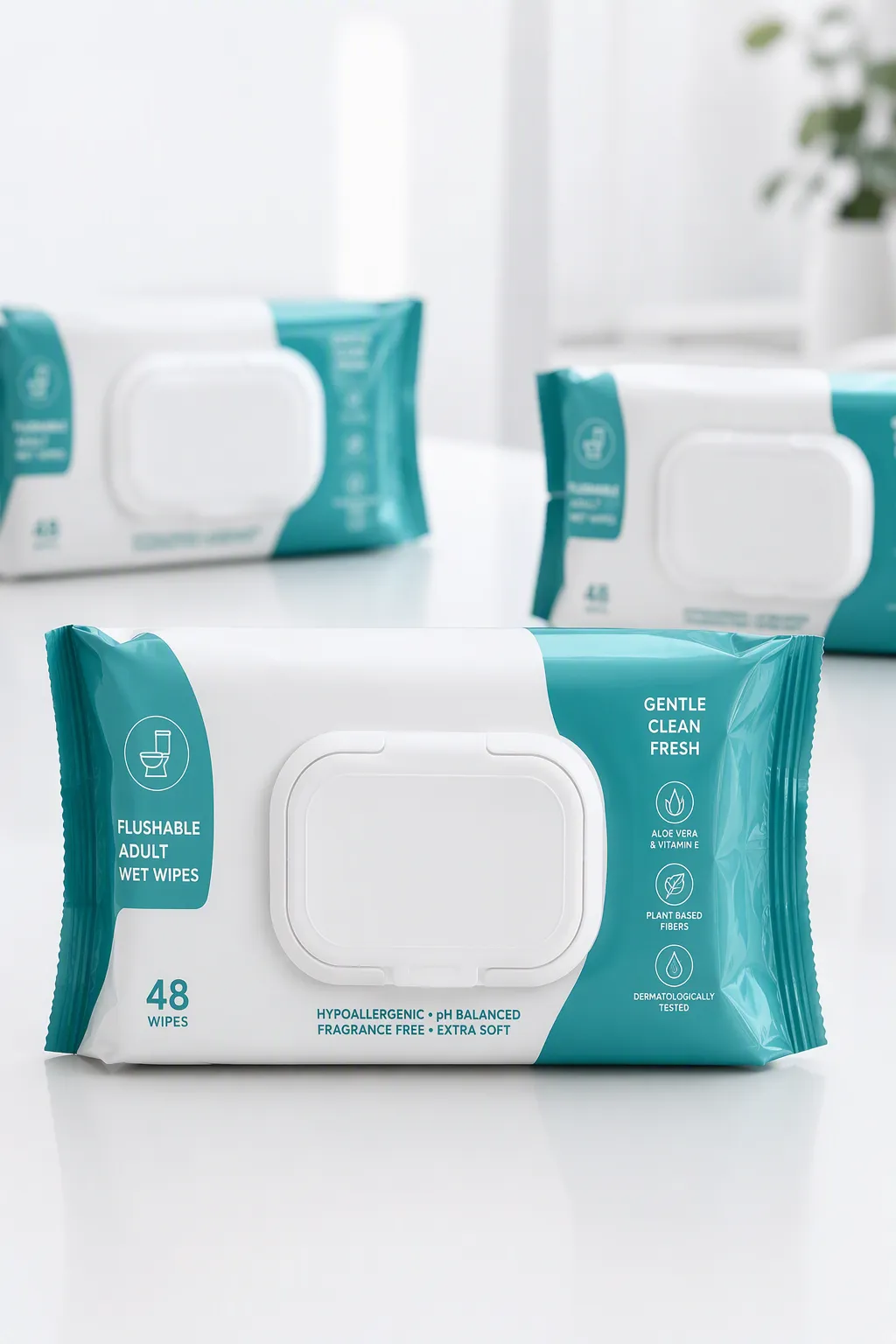
“Flushable” is a claim, not a self-declaration. In practice buyers are asked to show test evidence against a recognised guideline — the INDA/EDANA GD4 protocol or the IWSFG specifications — before a supplier will print the word on a pack destined for a state with a labelling statute. We covered the test sequence itself in our GD4 and IWSFG testing walkthrough, and the manufacturing side in our flushable wipes OEM page.
The state patchwork
INDA’s own account of its advocacy work names the states where model Do Not Flush labelling requirements have been enacted: California, Oregon, Illinois, Washington, New Jersey and Colorado. The requirements share a common shape — a symbol plus the words “Do Not Flush”, placed prominently on the pack — but they were adopted at different times and are not identical in geometry or wording.
| Layer | Status as of November 2026 | What it means for your artwork |
|---|---|---|
| Enacted state laws (CA, OR, IL, WA, NJ, CO) | In force in each state on its own terms | One artwork cannot be assumed compliant everywhere. Check the statute for each state you ship into, and check whether the requirement attaches to the package, the label or both |
| Other states with active bills | Introduced or carried over, not enacted | Watch list. A national label design is the cheapest hedge against the patchwork growing |
| Federal WIPPES Act | Passed the House; pending in the Senate; not law | Design to the federal shape now and you are ready if it passes. Do not print “WIPPES compliant” on a pack |
Where the WIPPES Act stands
The Wastewater Infrastructure Pollution Prevention and Environmental Safety Act would set a single national Do Not Flush labelling standard and give enforcement a federal home. Two features of the bill matter to manufacturers more than the politics:
- It would pre-empt the patchwork, not add to it. The commercial value of the bill is that one artwork would work in all fifty states, which is why the industry has pushed for it rather than against it.
- It has to reconcile with FIFRA. Disinfecting wipes already carry an EPA-approved label, and INDA’s position explicitly addresses coordinating the Do Not Flush label with existing FIFRA-mandated labelling so the two do not collide on the same panel.
Until it is signed, the operative rules remain state law. A supplier telling you “the federal rule covers this” is describing a bill, not a statute.
Disinfecting wipes: two labelling regimes on one pack
This is the part of the category where label failures get expensive, because a disinfecting wipe is regulated twice:
| Regime | What it controls | What happens if you get it wrong |
|---|---|---|
| State Do Not Flush requirements | Presence, prominence and wording of the flush warning | Product can be pulled from retail in that state; the brand owner carries the exposure |
| FIFRA / EPA pesticide labelling | Claims, directions for use, hazard statements, the approved master label | A label that deviates from the approved master label is a misbranded product |
The trap is additive: teams add the Do Not Flush symbol to satisfy a state law and, in doing so, disturb a panel or a claim block that was approved under FIFRA. The fix is procedural rather than creative — the flush warning is placed in a fixed zone agreed with the registrant before artwork starts, not dropped in at proof stage.
Five checks that decide whether your label holds
| Check | What a pass looks like | Typical fail |
|---|---|---|
| Product classification | A written determination that the SKU is a premoistened nonwoven wipe not designed to be flushed | Product marketed as flushable with no test evidence — the question becomes a testing question, not a labelling one |
| Destination states | The shipping plan, not the registered address | Artwork approved for one state sold into six; e-commerce reaches all fifty from one warehouse |
| Placement | Warning on the panel the statute names, at the prominence it requires | “It’s on the back somewhere” when the requirement is the principal display panel |
| Size and wording | Symbol and wording together, sized relative to the panel as each statute prescribes | Symbol only, or paraphrased wording, or shrunk to fit around existing copy |
| Consistency with other regimes | No conflict with the FIFRA-approved panel on a disinfecting SKU | Warning added after label approval, disturbing an approved claim block |
How Riway handles US-bound artwork
Riway Group produces private-label wet wipes for buyers in more than 75 countries — including a dedicated programme for US-bound private label — and has done so for over 20 years, under ISO 9001, ISO 14001, ISO 45001, ISO 13485, GMP Cosmetic, ISO 22716, FSC, CE, Nordic Swan, Sedex and BSCI certification. On US private label the workflow is built around the fact that the label obligation belongs to the brand owner:
- Label zone locked at specification stage. The flush-warning zone is agreed before artwork is supplied, so a state-specific symbol does not displace a claim or a FIFRA block later.
- Artwork checked against the pack, not against a PDF. Film registration, seal area and curvature all change how a warning reads on a finished pack; we proof on the actual format.
- One film, several markets, separated by SKU. Where a buyer ships to both EU and US, we keep the marking sets as separate SKUs rather than trying to satisfy two regimes on one panel.
- Samples in 3–5 days on standard formats, so a label change can be validated before the print run rather than after it.
Questions buyers ask us
Is the WIPPES Act law yet?
No. It passed the House and is pending in the Senate. Until it is enacted, the enforceable requirements are the state statutes, and they differ. Design to the federal shape as a hedge, but do not label a product as compliant with a bill.
Which states currently require Do Not Flush labelling?
Per INDA’s advocacy record: California, Oregon, Illinois, Washington, New Jersey and Colorado. Because the list grows and the details differ, confirm the current position for each destination state before a print run rather than relying on a list — including this one.
Does a Do Not Flush label make a wipe non-flushable?
No. The label describes the product’s design intent. A wipe sold as flushable needs test evidence against a recognised flushability guideline; a wipe sold as non-flushable needs the warning. The label cannot substitute for the design.
We sell only on marketplaces. Does this apply to us?
Yes, if the product is sold into a state with an enacted requirement. Marketplace fulfilment does not create an exemption, and listing images that omit the required warning are a common finding because the artwork was approved for a different market.
Can the same artwork serve the EU and the US?
Rarely. The EU regime requires a harmonised marking telling consumers the product contains plastic; the US state regime requires a Do Not Flush warning with state-specific geometry. Combining them on one panel usually makes both weaker. Separate SKUs are cheaper than a recall.
What evidence should I keep?
Three things: the flushability test report if a flushable claim is made, the artwork approval record showing the warning position, and the master-label reference for any disinfecting SKU. Together they answer the only question an inspector or a retailer will ask — what did you rely on, and when.
Launching a US private-label wipe? Send the destination states and the pack format. We will return a label-zone layout and flag where a state requirement conflicts with your current artwork before you commit to print.
Sources
- INDA, Wipes Policy — state enactments and WIPPES Act position — inda.org
- WIPPES Act, H.R.2269 (119th Congress), bill status — BillTrack50
- WIPPES Act, S.1092 (119th Congress), bill status — BillTrack50