
Short answer: For industrial wipes the solvent decides the substrate, not the other way round. Polypropylene handles alcohols, alkalis and most aqueous chemistry but swells in aromatic and chlorinated solvents. Polyester handles alcohols, ketones and oils but is attacked by strong alkalis. Cellulosic substrates (viscose, cotton, pulp) tolerate most organic solvents but lose strength in water and are degraded by strong acids. And the part that fails first in service is rarely the fibre — it is the binder, the print, or the pack.
Start with the solvent, not the substrate
Buyers usually arrive with a substrate in mind — often the one already in the catalogue — and then discover the solvent attacks it. The cheaper sequence is the reverse: name the chemistry, then let the substrate follow.
Four properties of the solvent decide the answer: polarity, aromaticity, halogen content, and concentration. A 5% IPA wipe and a 99% IPA wipe are not the same product even though the label reads the same, and a 10-minute contact is a different test from a 24-hour soak in a closed canister.
Compatibility matrix
| Solvent class | Polypropylene | Polyester (PET) | Viscose / cotton / pulp | Notes |
|---|---|---|---|---|
| Water, surfactant solutions | Suitable | Suitable | Test first | Cellulosics lose strength when wet; that is normal, not a defect, but it must be designed for |
| Alcohols (IPA, ethanol) | Suitable | Suitable | Suitable | The most common industrial wipe chemistry, and the easiest to specify |
| Ketones (acetone, MEK) | Test first | Suitable | Suitable | Ketones attack many latex binders, which is where an airlaid wipe fails |
| Aliphatic hydrocarbons (white spirit, diesel, kerosene) | Suitable | Suitable | Test first | Cellulosics handle the chemistry but the wipe may become hydrophobic and stop absorbing |
| Aromatic hydrocarbons (toluene, xylene) | Not recommended | Test first | Suitable | PP swells and loses tensile; a common failure in workshop degreasing wipes |
| Chlorinated solvents (DCM, perchloroethylene) | Not recommended | Test first | Test first | Aggressive to most polymers and to print; also a packaging compatibility issue |
| Esters and glycol ethers | Test first | Suitable | Suitable | Increasingly common in low-VOC formulations; binder and print are the weak points |
| Strong alkalis (caustic) | Suitable | Not recommended | Test first | PET hydrolyses; cellulosics swell and lose dimensional stability |
| Strong acids | Suitable (dilute) | Test first | Not recommended | Cellulosics degrade quickly; concentrated mineral acids are out for every substrate here |
| Oxidisers (hypochlorite, peroxide) | Test first | Test first | Not recommended | Cellulose is oxidised and embrittled; also a stability problem over shelf life |
This matrix is a starting point for a conversation, not a clearance. Concentration, temperature and contact time change the answer, and a substrate that survives a 10-minute wipe can fail after a week in a sealed canister.
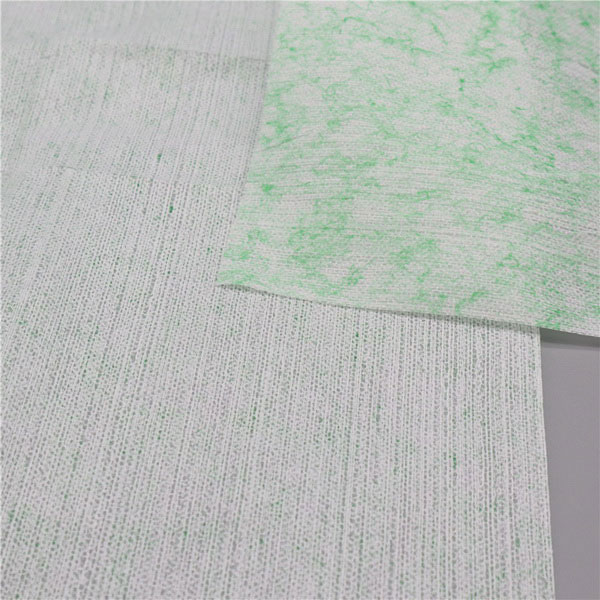
What usually fails first
In service complaints on solvent wipes, the fibre is rarely the culprit. The order of failure we see is consistent:
- The binder. Airlaid and some wet-laid webs rely on a latex binder. Ketones, esters and aromatics can soften or dissolve it, and the wipe then sheds or delaminates while the fibre itself is untouched.
- The print and the label adhesive. Solvent vapour attacks inks and pressure-sensitive adhesives from the inside of the pack. The wipe survives, the branding does not.
- The pack. A film that is fine with water can swell, craze or lose seal strength with a solvent. This shows up as leaking canisters or wipes drying out, and it is a packaging test, not a substrate test.
- The lotion chemistry. A solvent that is compatible with the substrate may not be compatible with the surfactant or the corrosion inhibitor in the same formulation.
How to test a combination
| Test | Method | What it catches |
|---|---|---|
| Immersion soak | Submerge the finished wipe in the target chemistry at application temperature; assess at 1 hour, 24 hours and 72 hours | Gradual strength loss and swelling that a spot test misses |
| Mass and dimension change | Weigh and measure before and after; express as percentage change | Swelling, shrinkage, and fibre loss |
| Tensile retention | Wet tensile after soak against dry baseline, both directions | The real usability limit — the point where it tears in the hand |
| Lint and shedding | Wipe a dark, smooth test surface and inspect under oblique light | Binder breakdown, which tensile testing can miss |
| Pack compatibility | Store the filled, sealed pack at elevated temperature for the intended shelf life | Seal failure, film swelling, print attack, lotion separation |
Specifying a solvent wipe
An RFQ that produces a usable quote names the chemistry rather than the product category:
| Line | Write this | Not this | Why it changes the answer |
|---|---|---|---|
| Solvent | “IPA 70% w/w, no co-solvent” | “alcohol wipe” | Concentration and co-solvents decide whether the substrate and the binder survive |
| Contact pattern | “single wipe-down, 30 seconds” | “for cleaning” | A soak for hours and a 30-second pass are different tests |
| Surface | “powder-coated steel, no scratching permitted” | “industrial surfaces” | Scratch and lint requirements can outrank absorbency |
| Pack and shelf life | “1.5 L canister, 24 months” | “any pack” | Solvent wipes fail on seal integrity more often than on fabric |
| Regulatory context | “food-production area, EU” | — | Food-contact and medical use add obligations beyond the substrate |
How we build industrial wipes
Riway Group has manufactured wet wipes and dry nonwoven products for over 20 years and exports to more than 75 countries. The material options behind each substrate are set out in our nonwoven material guide, and we work under ISO 9001, ISO 14001, ISO 45001, ISO 13485, GMP Cosmetic, ISO 22716, FSC, CE, Nordic Swan, Sedex and BSCI certification. On solvent wipes we work in this order:
- Chemistry review before substrate proposal. We ask for the solvent and the contact pattern first, then propose two substrate options with the trade-off stated in numbers.
- In-house laboratory testing on site covers the routine checks — mass, thickness, tensile, absorption — so a compatibility question can be answered before a production run rather than after.
- Pack and substrate tested as a system, because a solvent wipe that leaks in a canister has failed regardless of how good the fabric is.
- Samples in 3–5 days on standard substrates, supplied dry or pre-saturated so the buyer can run their own field trial.
Questions buyers ask us
Which substrate is best for acetone?
Polyester usually performs better than polypropylene with ketones, and cellulosics tolerate them chemically. The limiting factor is normally the binder in an airlaid web, which is why we test the finished wipe rather than the fabric alone.
Why did our PP wipes go limp in toluene?
Polypropylene swells in aromatic hydrocarbons and loses tensile as the polymer absorbs solvent. That is a material limit rather than a quality defect; the usual fix is a different substrate, or a change of chemistry if the application allows it.
Can a cellulosic wipe be used with water-based chemistry?
Yes, but design for the strength loss. Wet cellulose is weaker than dry cellulose, so the GSM and bonding have to be chosen for the wet state, and the pack has to prevent the wipe sitting in excess liquid.
Does the print really matter?
It does in solvent products, because vapour attacks ink and adhesive from inside the pack. We specify solvent-resistant inks for these ranges, and we test the printed pack, not just the film.
Can you supply pre-saturated solvent wipes?
Yes, where the substrate, pack and transport classification all support it. Solvent-saturated wipes are a dangerous-goods question as well as a manufacturing one, and the classification has to be settled before the format is chosen.
How long does a compatibility test take?
A basic soak-and-tensile comparison can be run in a few days. A full pack stability programme runs for the intended shelf life at elevated temperature, and that is the part that determines the launch date, not the fabric trial.
Developing a solvent or degreasing wipe? Tell us the chemistry, the concentration and what the wipe touches. We will propose two substrates with the trade-off stated, and test the finished wipe against your solvent before quoting.
Sources and references