
Short answer: The EU Packaging and Packaging Waste Regulation (PPWR) has applied since 12 August 2026. Its headline PFAS restriction covers food-contact packaging only — a standard wet-wipes pouch or canister is not food-contact packaging, so that threshold is not the test your pack has to pass. What does apply to wipes packaging is a sequence of later obligations: harmonised labelling from 2028, and recyclability plus mandatory recycled content from 2030. Separately, the wipe itself — not its pack — is already covered by the Single-Use Plastics Directive marking rules.
What the PPWR changed on 12 August 2026
The PPWR — the EU Packaging and Packaging Waste Regulation, Regulation (EU) 2025/40 — is the single rulebook that now governs every pack placed on the EU market: how it is designed, what it is made of, what is printed on it and what happens to it after use. It replaced the 1994 Packaging and Packaging Waste Directive with a directly applicable regulation, which means the same rule now applies in every Member State without national transposition. It entered into force in February 2025 and its obligations begin to apply in phases rather than all at once. On the first application date, three things became true:
- A single EU framework governs packaging design, labelling and end-of-life, replacing fragmented national schemes.
- Food-contact packaging containing PFAS above the new limits can no longer be placed on the EU market.
- The rest of the framework was scheduled, not switched on — labelling in 2028, design and recycled-content obligations in 2030.
That phasing is why so much of the PPWR conversation in the wipes category is currently wrong in both directions: some suppliers treat it as already fully in force, others treat it as a 2030 problem. Neither is accurate.
The PFAS limit does not apply to your wipes pouch
The PFAS restriction is drafted around food-contact packaging — takeaway containers, fast-food wrappers, microwave popcorn bags, bakery paper, pizza boxes. Grease and water repellency in food packaging was the exposure route the measure targets.
A wet-wipes pouch is packaging, but it is not food-contact packaging. So when a supplier tells you their laminate “complies with the PPWR PFAS limits”, the statement is technically true and operationally unhelpful: it describes a threshold that does not bind your pack. The questions that do change your pack are different ones.
| Wrong question | Right question | Why it matters |
|---|---|---|
| “Is the film PFAS-free?” | “What is the mono-material share of the laminate, by weight?” | Recyclability from 2030 is a design question, and laminates are where wipes packaging fails it |
| “Does it meet the PFAS threshold?” | “Is any layer PVC, PVDC or metallised?” | These layers are the usual blockers for a polyolefin recycling stream |
| “Is the pouch recyclable?” | “Recyclable in which stream, in which Member State, at what sortation?” | Design-for-recycling claims are only meaningful against a named stream |
| “Can you add the recycling logo?” | “Which harmonised label applies from 2028, and where on the pack?” | Labelling becomes harmonised across the EU, so national marks stop being sufficient |
The three dates that do apply
| Date | Obligation | What it means for a wipes SKU |
|---|---|---|
| 12 August 2026 | PPWR applies; PFAS limits for food-contact packaging | Wipes pouch unaffected by the PFAS threshold. If you also pack food-contact wipes or food-service sachets, that part of your range is affected |
| 2028 | Harmonised EU labelling system for packaging | Artwork changes: material and sorting information in one format, replacing national marks. Budget a full artwork round, not a sticker |
| 2030 | All packaging recyclable; mandatory recycled content in plastic packaging; empty-space limits; restrictions on certain single-use plastic packaging; reuse targets | The structural deadline. A mixed-material laminate designed today has to be recyclable in four years, and the film has to carry recycled content |
The 2030 package is the one that requires action now, because packaging structures are specified years ahead of a launch and a film change re-opens the stability and seal-integrity testing of the whole SKU.
The wipe is a separate regime from the pack
Two different laws are routinely conflated in wipes compliance conversations. The PPWR governs the packaging. The wipe itself is a product, and in the EU it falls under the Single-Use Plastics Directive, which already requires a harmonised marking on wet wipes to tell consumers the product contains plastic and should not be flushed. That marking obligation did not start in August 2026 — it predates the PPWR and continues alongside it.
So a wipes SKU sold in the EU can be carrying three separate compliance threads at once: a marking on the wipe’s own pack under the SUP rules, a packaging-labelling obligation arriving in 2028, and a packaging-design obligation arriving in 2030. Treating any one of them as “the PPWR requirement” produces a pack that passes one check and fails the next.
Recyclability risk by pack format
The 2030 design obligation does not treat all wipes formats equally. The risk is concentrated in two places: mixed-polymer laminates, and small formats that fall through sortation.
| Format | Structure commonly specified today | Risk by 2030 | What has to change |
|---|---|---|---|
| Doypack / refill pouch | PET/PE or PET/AL/PE laminate | High — mixed polymers, and aluminium blocks the polyolefin stream | Mono-PE or mono-PP, with barrier delivered by the sealant rather than a metal layer |
| Canister / tub | PP body, often a PET or paper label, PP lid | Medium — the body is usually fine, the label and lid decide the outcome | Same-polymer label and lid, wash-off adhesive |
| Single sachet / flow wrap | PET/AL/PE | Very high — small format and multi-layer at the same time | The hardest format to keep. Expect format consolidation rather than a material fix |
| PE film multipack | LDPE shrink or wrap | Low to medium — already mono-material | Recycled content and thickness reduction |
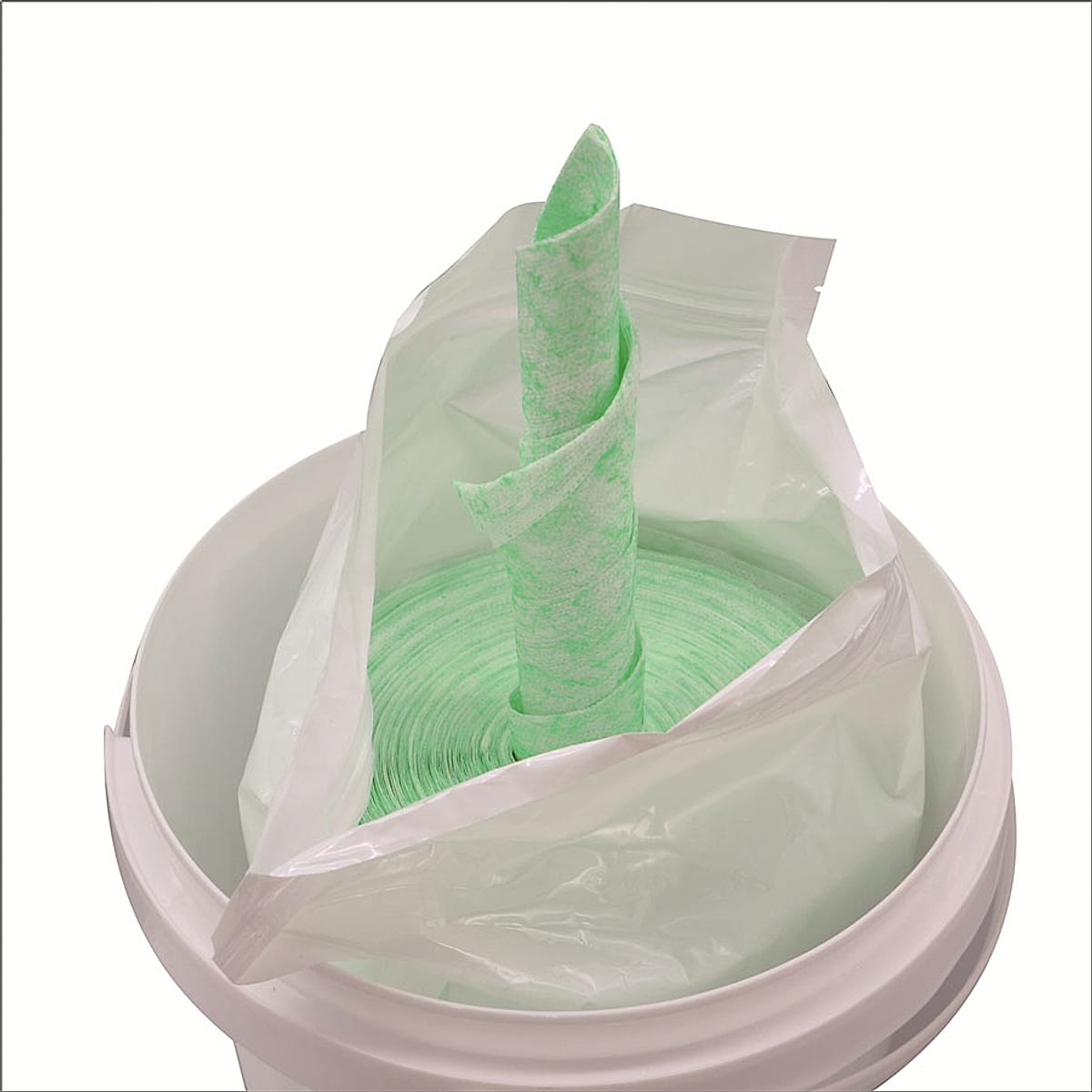
What a future-proof pouch looks like
Based on the 2030 design obligation, the direction of travel for wipes packaging is consistent across formats:
- Mono-material polyolefin structures wherever barrier allows, in place of PET/PE or PET/AL/PE laminates.
- No PVC or PVDC layers, and metallised layers only where the barrier requirement genuinely cannot be met otherwise.
- Low-ink coverage and removable or wash-off adhesives, so the film stays in its intended stream.
- Label and closure in the same polymer family as the body — the flip-top lid is the most common single cause of a “recyclable pouch” failing sortation.
- Right-sized pack for the fill count, because empty-space limits arrive in the same 2030 package.
None of this is free. Mono-PE structures typically cost more per kilogram than a metallised laminate and run slower on some filling lines, which is why the conversation has to happen at the specification stage rather than at the artwork stage.
How Riway quotes packaging today
Riway Group has supplied private-label wet wipes to more than 75 countries for over 20 years, and holds ISO 9001, ISO 14001, ISO 45001, ISO 13485, GMP Cosmetic, ISO 22716, FSC, CE, Nordic Swan, Sedex and BSCI certification. On packaging specification we work in the order that the regulation does:
- Stream first, then structure. We ask which Member State and which collection stream the pack is designed for before proposing a laminate, because “recyclable” without a stream is a claim, not a specification.
- Both structures quoted side by side. Where a buyer wants to move off a mixed laminate, we quote the mono-material alternative against the current structure with the cost and line-speed difference stated, so the decision is made on numbers rather than on a sustainability slide.
- Compatibilised mono-PE doypacks and canisters are available across our standard wipe formats — the full format set is in our packaging options guide —, including flushable and baby ranges where the pack has to carry a SUP marking as well.
- Sample packs in 3–5 days, so a film change can be tested for seal integrity and moisture loss before it is committed to a print run.
Questions buyers ask us
Is my wipes pouch “PPWR compliant” today?
The PPWR has applied since 12 August 2026, but the obligations that reshape a wipes pouch — harmonised labelling and the 2030 design package — are phased. Today the accurate statement is that the pack must meet the general requirements in force, while the design obligations that will force a structure change arrive in 2030. Ask a supplier to name the date they are designing to.
Do I need a PFAS declaration for a wet-wipes pouch?
Not to satisfy the PPWR food-contact restriction, because your pouch is not food-contact packaging. You may still be asked for one by a retailer’s own chemical policy, which is a commercial requirement rather than a PPWR obligation. The two should not be quoted interchangeably.
Does recycled content apply to wipes film?
Mandatory recycled content in plastic packaging applies from 2030, and contact-sensitive applications have their own trajectory because recycled resin has to meet the same safety standard as virgin. Start the conversation with your film supplier now; the qualification cycle is longer than the artwork cycle.
Can we keep the current laminate and add a recycling logo?
A logo does not change sortation. If the structure is a mixed laminate with a non-compatible lid, it will not pass design-for-recycling assessment in 2030 regardless of what is printed on it. Fix the structure, then label it.
What about the UK?
The UK is not covered by the PPWR. It has its own track: the single-use wet-wipes restrictions on plastic-containing wipes phasing in from December 2026, plus national packaging producer responsibility. A pack designed only against the PPWR will need a separate UK review — we set out the dates and the covered product list in our UK and EU plastic wipes ban guide.
Which is the bigger risk, the pack or the wipe?
The wipe. A plastic-containing wipe now faces supply restrictions in the UK, and a “flushable” claim is the most litigated word in the category. Packaging is a design problem with a known 2030 deadline; the wipe itself is a market-access problem with deadlines already running.
Specifying a pack for 2028 and 2030 in one move? Send the format, fill count and target markets. We will quote the current structure and a mono-material alternative side by side, with the label and marking requirements for each market.
Request a packaging quote → · See how our OEM process works →
Sources
- European Commission, “New EU rules on packaging enter into application”, 11 August 2026 — environment.ec.europa.eu
- Regulation (EU) 2025/40 on packaging and packaging waste — EUR-Lex
- Directive (EU) 2019/904 on the reduction of the impact of certain plastic products on the environment — EUR-Lex