
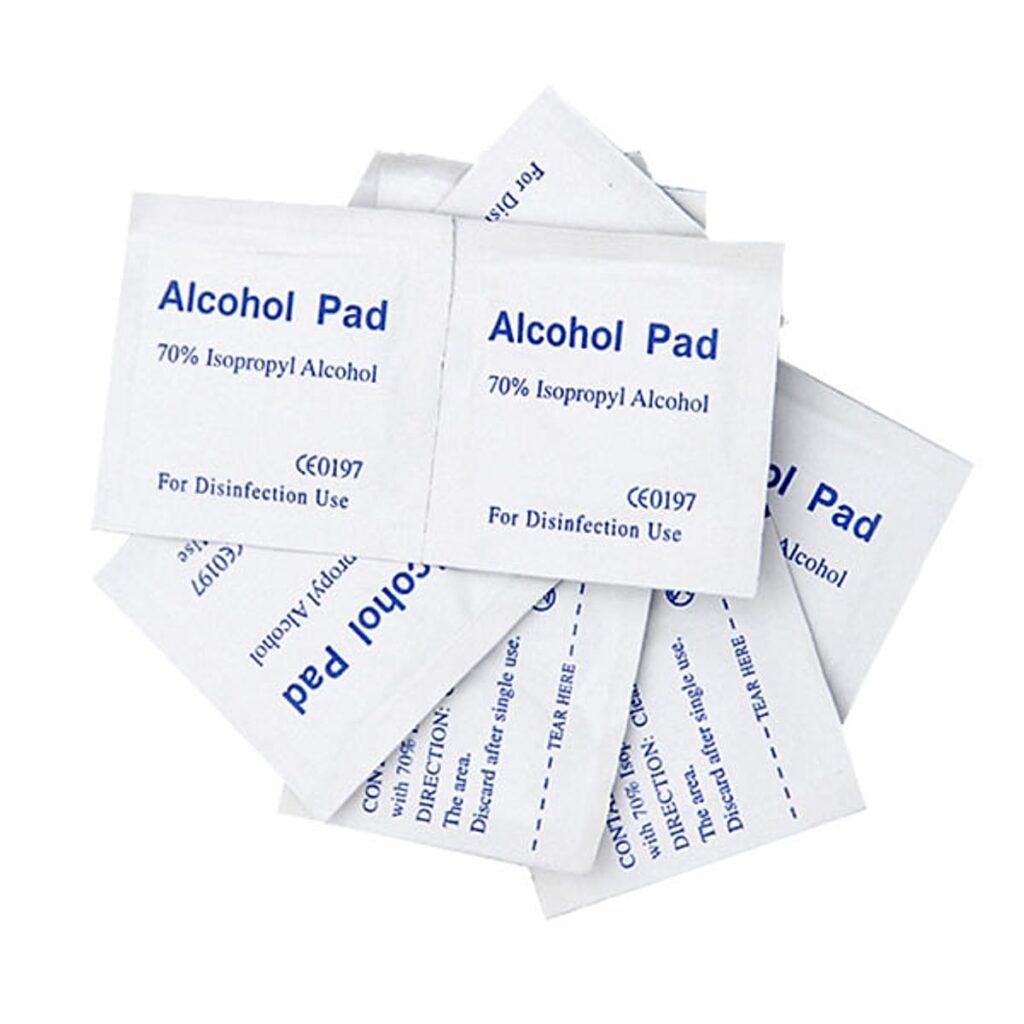
An alcohol pad matters because it cleans and disinfects skin in one step, without water, soap or a separate applicator. Individually wrapped and saturated with isopropyl alcohol, it is the standard preparation step before an injection, a finger-prick test or a first-aid dressing, and it is equally at home wiping a phone screen or cleaning a tool. Small, sealed and single-use, it is one of the most widely used medical disposables there is.
What an alcohol pad is made of
A prep pad is a small nonwoven or pulp sheet saturated with isopropyl alcohol, sealed in an individual foil or film sachet. Three parts decide how well it performs:
- The wipe — a soft, low-lint nonwoven cut to size, typically around 65×30 mm for a finger-prick pad and larger for a skin-prep pad.
- The saturation — 70% isopropyl alcohol by volume is the usual concentration for skin preparation.
- The seal — a multilayer foil or film sachet that stops the alcohol evaporating before the pad is opened.
Why 70% alcohol is used rather than 100%
Higher concentration is not automatically better. Alcohol kills microorganisms by denaturing protein, and that process needs water to work properly. In practice a 70% solution penetrates cell walls and denatures protein more effectively than a stronger one, while a near-pure solution can coagulate the outer layer and leave the cell underneath intact. The water also slows evaporation, so the pad stays wet long enough to cover the whole area being cleaned. That is why 70% isopropyl alcohol became the standard for prep pads rather than the strongest available concentration.
Where alcohol pads are used
- clinical preparation before injections, blood sampling and cannulation;
- home diabetes testing, where a pad prepares the fingertip;
- first aid, to clean the skin around a minor wound and to wipe tools such as tweezers;
- laboratories and electronics, where a controlled wipe is needed for a small surface;
- everyday hygiene, from cleaning a phone screen to wiping hands where no sink is available.
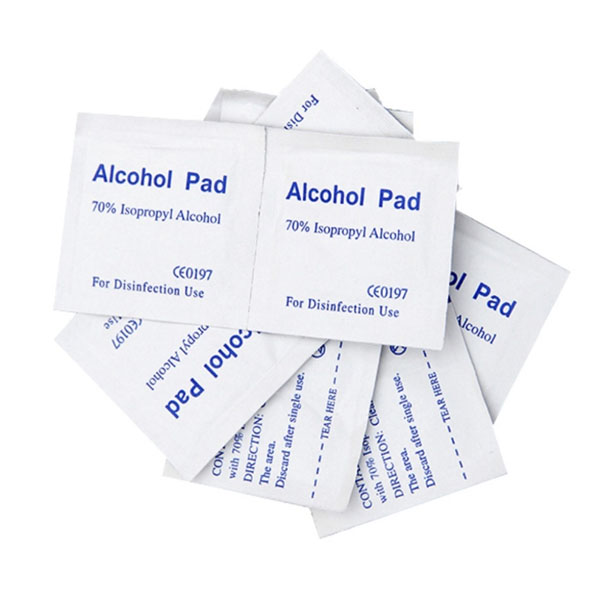
What to check when buying alcohol pads
The differences between suppliers show up in the details rather than the headline price:
- the actual alcohol concentration, stated by volume and supported by a specification sheet;
- the sealed construction — a four-layer seal holds the alcohol far longer than a single-layer film;
- the wipe material and its lint level, which matters on a screen or a lens;
- the pad dimensions, so the pad covers the area the use case requires;
- shelf-life data, because an evaporated pad no longer does its job;
- whether a batch certificate of analysis ships with the order.
Ask for the specification and a sample before choosing on price. The cost difference between a properly sealed pad and a cheap one is small; the difference in performance when it is opened two years later is not.
Frequently asked questions
How long does an alcohol pad stay wet?
That depends on the sachet seal and the storage conditions rather than the pad itself. A properly sealed multilayer sachet keeps the alcohol in place for the full shelf life; a poor seal loses it well before the printed date.
Is 70% alcohol strong enough to disinfect skin?
Yes — 70% isopropyl alcohol is the standard concentration for skin preparation, because the water content lets the alcohol penetrate rather than evaporate from the surface.
Can alcohol pads be made in custom sizes?
Yes. Pad dimensions, saturation level, wipe material and sachet film can all be set to your specification, including printed artwork on the sachet.
Do alcohol pads ship with documentation?
Every order ships with a batch certificate of analysis for traceability, and specification sheets are available before ordering.
See the product specification on our 70% isopropyl alcohol prep pads page, or the wider disinfecting and medical wipes range. For nonwoven substrate background, see EDANA. Or request a quote with your pad size and pack count.
Alcohol pads, swabs and wipes: what is the difference?
The three are related but not interchangeable. An alcohol pad is a flat sheet saturated with isopropyl alcohol in a sealed sachet, used for skin preparation and small surfaces. An alcohol swab is the same idea on a stick, used where you need to reach into a small opening. An alcohol wipe is a larger sheet for cleaning equipment, tools or a screen.
The choice follows the job: a pad prepares skin, a swab cleans a connector, a wipe cleans a surface. Where a buyer needs more than one of these uses, the practical answer is usually to carry two formats rather than to ask one product to do both, because the pad size and the saturation level are set by the use case.
For all three, the same rule applies: check the alcohol concentration by volume, check the seal, and ask for the shelf-life data before you commit to a print run.
If you are sourcing an alcohol pad for a clinic, a pharmacy chain or a first-aid range, put the pad size, the alcohol concentration and the pack count in the first message. Those three variables set the wipe material, the saturation level and the sachet film, so a complete brief shortens sampling to about a week. If you are sourcing an alcohol pad for a clinic, pharmacy chain or first-aid range, ask for the specification sheet with the sample, so the concentration and the seal are on record before the first production order.